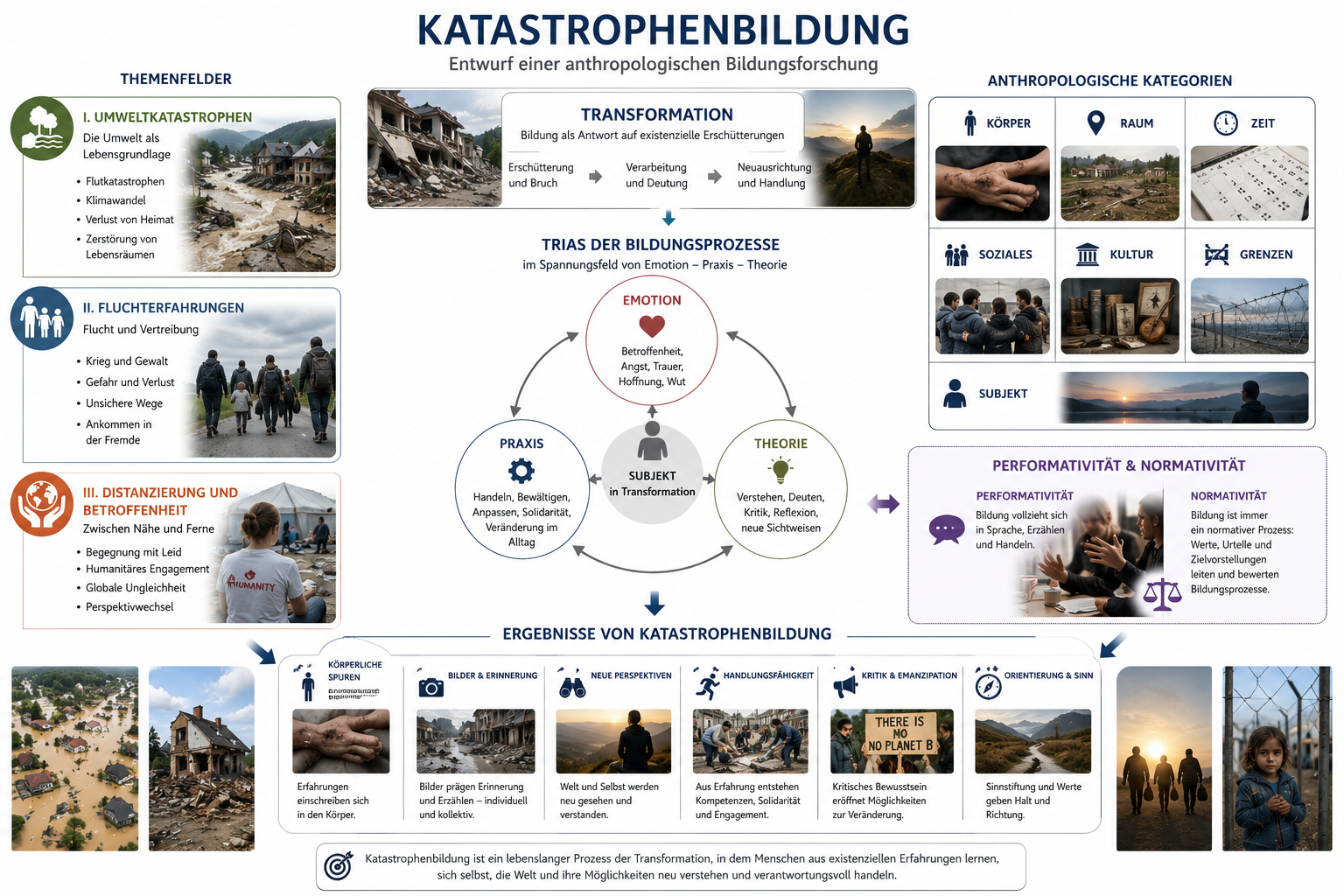
 Unser Buch: Katastrophenbildung. Entwurf einer anthropologischen Bildungsforschung ist am 18.12.2025 erscheinen. Die Leseprobe und das Inhaltverzeichnis kann man über den Verlag: Beltz Juenta einsehen.
Ein Rezension unseres Buches von Patrick Stobbe (Hamburg) findet sich hier:
Patrick Stobbe (Hamburg): Rezension von: Tim Schmidt/ Moritz Krebs/ Timur Rader/ Liesa Schamel/ Birgit Schulz/ Jörg Zirfas: Katastrophenbildung. Entwurf einer anthropologischen Bildungsforschung. Weinheim: Beltz Juventa 2026 (294 S.; ISBN 978-3-7799-9423-7; 48,00 EUR). In: EWR 25 (2026), Nr. 2 (Veröffentlicht am: 24. April 2026), URL: https://ewrevue.de/2026/04/katastrophenbildung-entwurf-einer-anthropologischen-bildungsforschung/
Teil 1: Was meint anthropologische Bildungsforschung?
Zum Begriff der Katastrophe
Zum Begriff der Katastrophenbildung
Zur Methode der anthropologischen Bildungsforschung
Entstehung, Darstellung und Dank
Teil 2: Umweltkatastrophen
Die Umwelt als Lebensgrundlage
Pattie: Die Flutkatastrophe im Ahrtal
Thea: Der Kampf um die Lebensgrundlagen bei Garzweiler
Nostalgische und solidarische Bildung
Teil 3: Fluchterfahrungen
Flucht und Flüchtlinge
Erzählen, Sprachbarrieren und Berichten
Malek: „Also faaaaast eehm. ertrunken, sagt man?“ – Flucht aus Syrien
Sadio: Die Flucht aus Eritrea und die Ausbildung zum Wasserbauingenieur
Pragmatische und emanzipative Bildung
Teil 4: Distanzierung und Betroffenheit
Die Geflüchteten im Lager und die Kosmopoliten in der Welt
Sarah: „Wie Kinder mit Ratten spielen“ – Arbeit in einem Flüchtlingscamp
Ashley: Aufwachsen in Afrika und Leben in Europa
Humanitäre und existenzielle Bildung
Teil 5: Empirie, Theorie und Normativität der Katastrophenbildung
Ergebnisse: Pädagogische Anthropologie und Katastrophenbildung
Empirie: Körperliche Transformationen
Anthropologie: Bilder, Phantasie und Zukunft
Normativität: Was ist ein guter Bildungsprozess?
Professionalität: Zur Bildung der Forscher:innen
English Version: Disaster and Education. The perspective of anthropological educational research
With the help of anthropological educational research, this article attempts to pursue the questions of what motivates people to educate themselves in and through disasters, what content they focus on, what forms their development processes take and what goals they pursue in doing so. Specifically, we aim to develop a concept of disaster education, which we want to formulate theoretically and empirically in relation to experienced and impending disasters, and to make initial considerations about anthropological educational research. This attempts to understand transformational educational processes with the help of pedagogical anthropology and narrative analysis. In this respect, this text has an experimental and explorative character. We focus education not only on reflexivity, but above all on emotionality and practice.
https://brill.com/view/journals/vfp/101/4/article-p527_7.xml